
Global Logistics Crisis: Traditional Trade Routes Under Threat
Regional conflicts in the Middle East and Eastern Europe, which have been ongoing for several years, are causing traditional trade routes to operate with restrictions. The search for alternative trade routes between states and the push to maintain the scale of trade relations are accelerating the formation of new trade routes. Consequently, this limitation drives a substantial increase in overall transportation expenditures. As a result, the prices of goods delivered to consumers are rising several times. However, alternative trade routes currently lack the capacity to accommodate large cargo volumes, primarily due to underdeveloped infrastructure. That is why countries that are shaping a new world order are increasing their investment in these areas because they are interested in de-escalating trade relations. Through such a strategic approach, they will be able to offer their standards as a reliable alternative in the international arena.
However, the beginning of negotiations between Iran and the United States indicates the emergence of a ceasefire between the two sides in certain directions. It is possible to agree that the parties are also ready to make concessions on certain issues in order to come to such a consensus. The introduction of a 60-day sanctions-free regime meant the opening of the world market again for Iran’s oil industry. As negotiations with the United States continue, it means that the development of events will remain abstract in the short term.
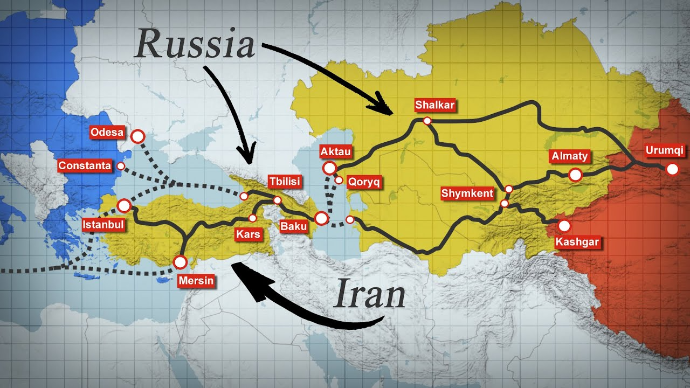
Factors shifting traditional trade routes
The crisis of traditional trade routes is symbolically associated with the outbreak of military conflict between Russia and Ukraine. The deterioration of relations between the European Union and Russia due to the military invasion launched by Russia on February 24, 2022, alongside economic sanctions imposed by Western nations on key sectors of the Russian economy, including Russian Railways, has fundamentally altered the trade balance in Eurasia. By 2022, 86% of goods shipped from China to Europe were transported by rail via the Trans-Siberian Railway. As a result of these political decisions, which have significantly changed trade volumes along traditional trade routes, it remains beneficial for producers and consumers to quickly establish new alternative trade routes. The Middle Corridor, as an alternative trade route in the emerging world order, has the potential to systematically transform trade relations in the Eurasian region. The Middle Corridor, on the other hand, is pushing forward a new alternative trans-Caspian route, taking into account the current political situation. This could save 2,000 km of distance and take trade to a new level. The current increase in risks on maritime trade routes, including unpredictable scenarios of the scale of the conflict in the Middle East, and the status quo in the Strait of Hormuz and Bab al-Mandab, create many uncertainties. This leads to an increase in the distrust of safe transportation of cargo through the Suez Canal. As a result, the likelihood of trade relations returning to land again increases. Also, China’s strategic choice will determine in what order the trade in Eurasia will be in the near future. Chinese products enter the Middle East and then Europe via the Malacca Strait on the maritime trade routes. Almost 24% of global seaborne trade by volume flows through the strait. It carries 45% of the world’s seaborne oil, over 25% of all cars traded internationally and 23% of dry bulk cargo, including key agricultural commodities like grains and soybeans. A large portion of European imports of electronics, consumer products like footwear and toys, machinery, and industrial goods passes through the strait in sea containers as well. However, the expansion of military cooperation between Indonesia and the United States, one of the strategic countries located in the Strait of Malacca, on April 14, 2026, will lead to a change in the balance of power in the region. As a result, political sentiment in the Strait of Malacca can significantly affect world trade. China also has a project to reach the white Arabian Sea at the Port of Gwadar, Pakistan. The project was valued at $54 billion. Recent border skirmishes between Pakistan and Afghanistan, ongoing political disputes with India, and centrifugal tendencies in certain Pakistani regions seeking greater autonomy have rendered the future of this corridor highly uncertain.
Tensions in the Middle East
On February 28, 2026, the United States and Israel launched airstrikes on Iranian territory. The conflict has brought the situation in the Middle East to a state of unpredictability, with not only the parties to the conflict but also US military bases located in the territory of the countries of the region being targeted to this day. On several occasions, the cancellation of negotiations has caused the conflict to extend indefinitely. Considering that the region has 30% of the world’s oil reserves, it can cause a serious energy crisis around the world. Moreover, the strategic oil reserves of other regional countries that import oil from the Middle East, which have been released to the markets to stabilize prices, remain closely linked to the resolution of the situation in the Middle East. The blockade of the Strait of Hormuz is causing economic and energy changes not only for the countries of the Middle East but also for neighboring regions.
However, the start of negotiations between the United States and Iran, with some concessions on both sides, creates an opportunity for a consensus. The imposition of a 60-day sanctions-free regime by the US for Iranian oil has returned the world’s unstable oil prices, which have been rising for months, to the level before the outbreak of conflict between Iran, the US and Israel. In turn, these trends will not fail to affect the process of launching alternative trade routes. The unfolding events suggest that Iran’s exit from the sanctions regime and reintegration into the global market could significantly change the trade balance in the Eurasian region. Against the backdrop of the indefinite closure of the northern corridor, Iran’s consensus with the United States and regional countries could ensure that the Middle East participates as a land transit country in the formation of alternative trade routes. In turn, this gives impetus to the development of trade in cities located at the crossroads of the old Great Silk Road. As a result, the Middle East is likely to manifest as a connecting region between Europe and Asia.
On the contrary, there are several subjective and objective aspects that contradict this, and the course of events may be different from this interpretation. Iran has also suffered severe damage to certain key trade infrastructures, with the sides hitting strategic facilities in the conflict between the United States and Israel. To compensate for this damage, Qatar (and possibly the countries of the region as well) is offering humanitarian aid. However, it remains unclear how much of the $6 billion will be allocated specifically to the reconstruction of commercial ports and important commercial zones. In addition, the Iranian shooting of a cargo ship belonging to Singapore was condemned by US President Donald Trump, and it is said that retaliatory strikes were carried out. This situation is interpreted by Trump as a violation of the negotiation process.
Based on the analysis of the development of events, it can be summed up that distrust between the parties has not yet lost its relevance, but as a result of the resource limitation on the parties and the increased risk of crossing the last existential red lines to continue the escalation, the start of negotiations will fully respond to the current interests of the parties Therefore, such provocative strikes may not be considered sufficiently justified to break the ceasefire. The easing of sanctions will not only reveal Tehran’s potential as an oil exporter but also demonstrate its geographical potential in the newly emerging alternative land trade routes.
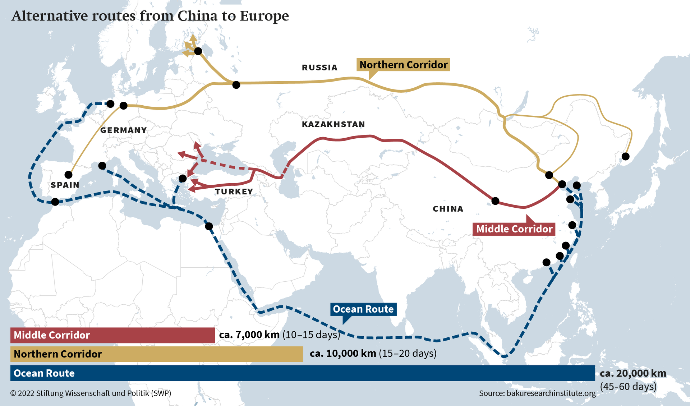
Changes in the balance of power in the South Caucasus
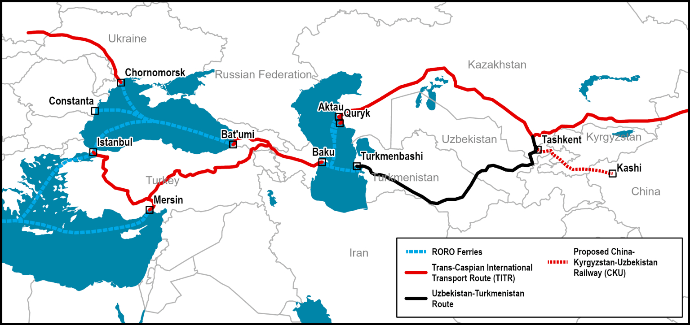
The victory of the Civil Contract party in the parliamentary elections in Armenia could further strengthen ties between Azerbaijan and Armenia in the South Caucasus. It will be possible to forget about historical and territorial disputes and pursue a pragmatic policy in developing liberal economic relations. Also, the connection of the two countries through the Zangezur corridor will ensure the more efficient operation of the Trans-Caspian route and increase the volume of cargo. The construction of a single railway directly connecting Azerbaijan, Armenia, and Turkey further increases logistical possibilities. Peace in the South Caucasus is manifested as a decisive hub in the new world order, which is taking shape. The pragmatic policy pursued between the two countries is visible on the international stage as an important crossroads in the Middle Corridor, an alternative corridor connecting East and West.
However, in light of recent developments in the Middle East, how relevant can the geographic attractiveness of the South Caucasus remain for the EU and China? The reason is that the Trans-Caspian Railway is characterized by multimodality, and complex infrastructure is required to transport goods to the other side of the Caspian Sea. The existing infrastructure’s cargo-carrying potential was 4.12 million tons in 2025 and is projected to reach 11 million tons by 2030. The Global Gateway aims to invest in the region’s countries and diversify the logistics gap between the EU and China with alternative trade routes. The controversial aspect of the issue is how much the Trans-Caspian corridor can become a hub in terms of infrastructure, even if the Zangezur corridor is operational. If in the Middle East the situation is changing and Iran reintegrates into the world economy, the Railway starting from China will split into two large networks after Central Asia, and since it is land, there is a chance that the passage of cargo through Iran to Turkey will be several times greater than in the Trans-Caspian corridor.
The role of Central Asia in connecting China and the EU by land
In the formation of the Trans-Caspian corridor, special emphasis should be placed on the position of the Central Asian states as well. Central Asia is geographically bordered by the present-day conflict regions of the Middle East, South Asia, and Eastern Europe. The geopolitical situation in these regions restricts Central Asia’s ability to access global markets, presenting distinct logistical challenges to its economic integration with the international community. However, the multi-vector pragmatic policy pursued by the Central Asian countries is an important element for the launch of the Middle Corridor, which connects the East and the West. Central Asian countries are considered a region that is geographically interested in the launch of the Trans-Caspian and Trans-Iranian corridors.
Conclusion
In short, as the balance of power in Eurasia shifts, the situation in the Middle East, South Asia, and Eastern Europe could trigger unpredictable levels of complex social, economic, and political change. It remains unclear which way the trade routes will shift. The unfolding events in Iran could shape the Middle East’s land-based logistics capabilities. The end of the Russia-Ukraine conflict could also return traditional trade routes to their pre-2022 state, delaying the implementation of alternative routes. Alternatively, against the backdrop of growing mistrust between Iran, the US, and Israel, with neither side willing to back down, leading to the indefinite postponement of negotiations and the continuation of the conflict in Eastern Europe in its current state, the development of the Trans-Caspian Corridor as a trade hub will be accelerated. The restriction of traditional trade routes requires the “invisible hand” of the market to respond to supply and demand, and there is a possibility that alternative routes will accelerate the realization of this. This could lead to capital being diverted to countries on the Middle Corridor, an alternative trade route in regions where conflict is ongoing. As a result, the current economic status quo in Eurasia is highly likely to undergo transformation in the near future.
Giyosbek Uskanboev,
Researcher, University of World Economy and Diplomacy (UWED)